
Meet Angie Hanson
she/her, MA, LMHC, LPCC
Who I Am
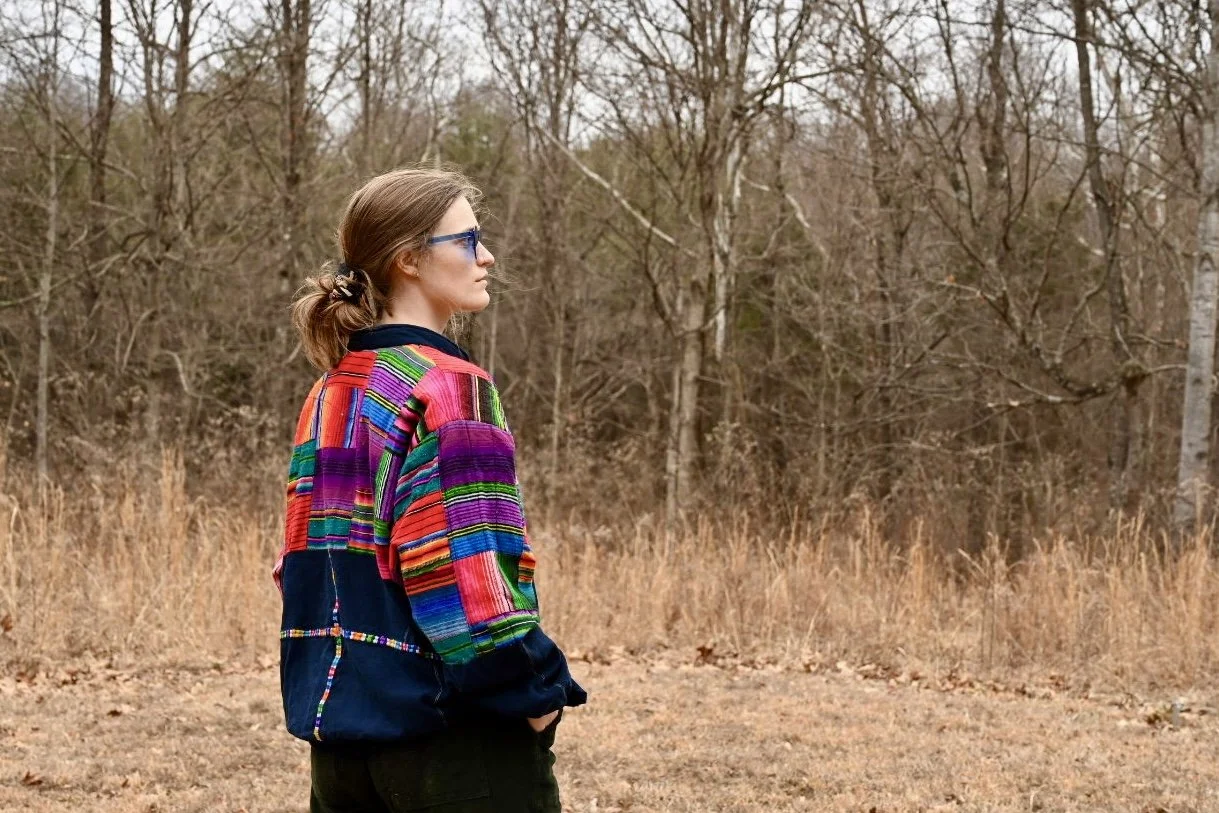
I am someone who is oriented to beauty and meaning. I love wandering around in nature. I am absolutely the slowpoke in the group who stops to say hello to flora and fauna along the way on a hike. I am regularly in awe of or amused by the world around me, constantly moved by the human spirit.
I keep a wide variety of hobbies and practices in my rotation, including rock climbing, pottery, paddling, reading, cooking, camping, photography, yoga, dancing, embroidery. Nonfiction podcasts/audiobooks are played at 2x speed, I very much enjoy my cat, James (featured in telehealth video appointments), and if I’m watching TV, it’s usually just Bob’s Burgers.
I see connections and patterns everywhere, I have one million ideas, and I have to wrestle with both the unique and universal limitations keeping me from knowing and experiencing everything.
“The curious paradox is that when I accept myself just as I am, then I can change.”
- Carl Rogers
I am intrigued by discomfort because I recognize the potential for growth and healing in that space. I believe in the work of therapy because it has and continues to transform me, and it is the privilege of a lifetime to hold space for others engaging at whatever depth they are ready to encounter.
There are a lot of facts and timelines to describe what has shaped me, people who have affected me, adventures I’ve had, various personal and professional forks in the road, but this is a bit of what it looks like to be me.
My Approach
In mental health, the answer to “what do I do about…?” is usually, “Well, it depends…”
With anxiety and depression, it could be that your body needs more or less movement, stimulation, nutrition, or rest. It could be that you are in an environment or relationship that isn’t aligned with your core values. It could be that there’s a chapter of your story that needs to be processed, witnessed, or understood in order to settle.
I view the symptoms or feelings as data, and our thoughts are the conscious interpretation of the data points. Sometimes the story we tell ourselves is inaccurate, and it’s my opinion that it can be very worth-while to learn how to slow down, become aware of the data from our bodies, and verify if the story is accurate.
For example, is it true that everyone hates me, or am I just hungry? Or, am I really justified to be this mad that another driver cut me off in traffic or is this intensity more related to the fear I’m holding that I might be insignificant as a person?
More often than we would like, inaccurate assumptions have great influence on our lives, even when we are aware of them.
An important aspect of why I am passionate about this work is attachment. Research indicates that the quality of the relationship is the primary predictor of therapeutic outcome. Therapy is a unique context where someone (in this case, me) is tracking, reflecting, being curious about, staying emotionally present with, and expressing compassion for you.
It can be uncomfortable and even terrifying to address certain aspects of the human experience, but to connect with our deeper selves in the presence of relational safety and connection can be extremely powerful.
I have an assortment of tools I am regularly refining in my therapist tool belt (accelerated experiential dynamic psychotherapy, dialectical behavioral therapy, cognitive behavioral therapy, internal family systems, Townsend model, Gottman method, mindfulness and experiential techniques), but my primary focus is on the relationship and what is happening between us that supports your reasons for coming to therapy to begin with.
Areas I Specialize In
-
Relationship anxiety
Co-dependency or people pleasing
Adult children of emotionally immature parents; adult children of alcoholics and dysfunctional families
Masking for neurodivergent folks or codeswitching for marginalized folks
Religious trauma and spiritual abuse
Religious deconstruction
Reclaiming spirituality after spiritual injury
Chronic illness and medical trauma
Adjusting to a life-altering diagnoses
Managing chronic illness
Emotional healing from a medical trauma
Body image and embodied self-trust
Sexual and gender identity
Body dysmorphia
Self-esteem and self-acceptance
-
We could talk for a long time about what a diagnosis means and the philosophy behind a term like “mental health disorder,” but to be brief, I have experience treating the following types of mental health disorders:
Depressive disorders
Anxiety disorders
Trauma and stressor-related disorders
Dissociative disorders
Somatic symptom and related disorders
Attention deficit hyperactive disorder (ADHD)
-
I will never know what it’s like to be you.
I am mindful of generalizing my knowledge and experience of various cultural identities by focusing on the guiding question, “how did this person’s experience as XYZ affect them?” rather than assuming you fit my limited idea of what I assume it means to be affected by XYZ.
I have listed group identities that I have substantial familiarity, training and/or professional experience with so you can know that you won’t have to spend an entire hour translating and teaching me about it. Like you, I personally belong in some of these groups and not others.
However, if you do not see yourself here, feel free to ask me about the extent of my knowledge with your group identities if that’s important to you (some folks prefer their therapist to have extensive knowledge on a subject, some prefer they have no pre-conceived notions). I want to help you find a good fit, regardless of that being me.
First and second generation immigrants to the United States
BIPOC folks
Folks using English as a second language
Deaf and Hard of Hearing
Neurodivergent folks
Folks with physical disabilities
Caretakers of loved ones
Christian faith traditions
Buddhist faith traditions
High-control religions
Spiritual/mystic beliefs
Healthcare professionals
Entrepreneurs and small-business owners
Queer or LGBTQ+ folks
Kink and/or poly folks
Facts and Timelines
The aforementioned facts and timelines are that I grew up near Louisville, Kentucky. I studied Psychology and Linguistics in Virginia, somewhat anticipating that I would become a speech therapist, but mostly because I felt the most interested in these subjects of the 11 majors I sampled.
After my undergrad, I was a trail guide in California, before attending graduate school in North Carolina for speech and language therapy. I decided before completing my degree here that this wasn’t what I wanted to pursue, quit the program, and got exposure in various healthcare professions.
Throughout my post-undergrad occupational soul searching, I had my own significant physical and mental health disruptions that completely undid and redirected me.
My therapist at the time was incredible, and I applied to her university to receive the same training as a mental health therapist. I then moved to Colorado to pursue a training institute, Forge Counseling Collective, with high priority on quality counseling student development. After a year and a half in the Rockies, I returned home to Louisville, Kentucky to be close to family.
Professionally, I continue to pursue advanced training to refine my psychotherapy skills, and I diversify my time by continuing to work as a professional photographer (sometimes blended with therapy!), teaching yoga, creating workshops centering on embodied expression and exploration, and collecting various odd jobs that stretch my knowledge and creativity.
Credentials
Licensed Mental Health Counselor in Indiana (LMHC 39006133A)
Licensed Professional Clinical Counselor in Kentucky (LPCA 308530)
Master of Arts in Clinical Mental Health Counseling from Concordia University Irvine 2024
Bachelor of Science in Psychology with a minor in Linguistics from Liberty University 2019
Advanced Certifications
Certified Gottman Level 1 from Gottman Institute 2024
Certified Ketamine Assisted Psychotherapy from Journey Clinical 2024
Certified Integrative Mental Health Practitioner from Bridge Academy 2025
Certified Accelerated Experiential Dynamic Psychotherapy Level 1 from AEDP Institute 2026